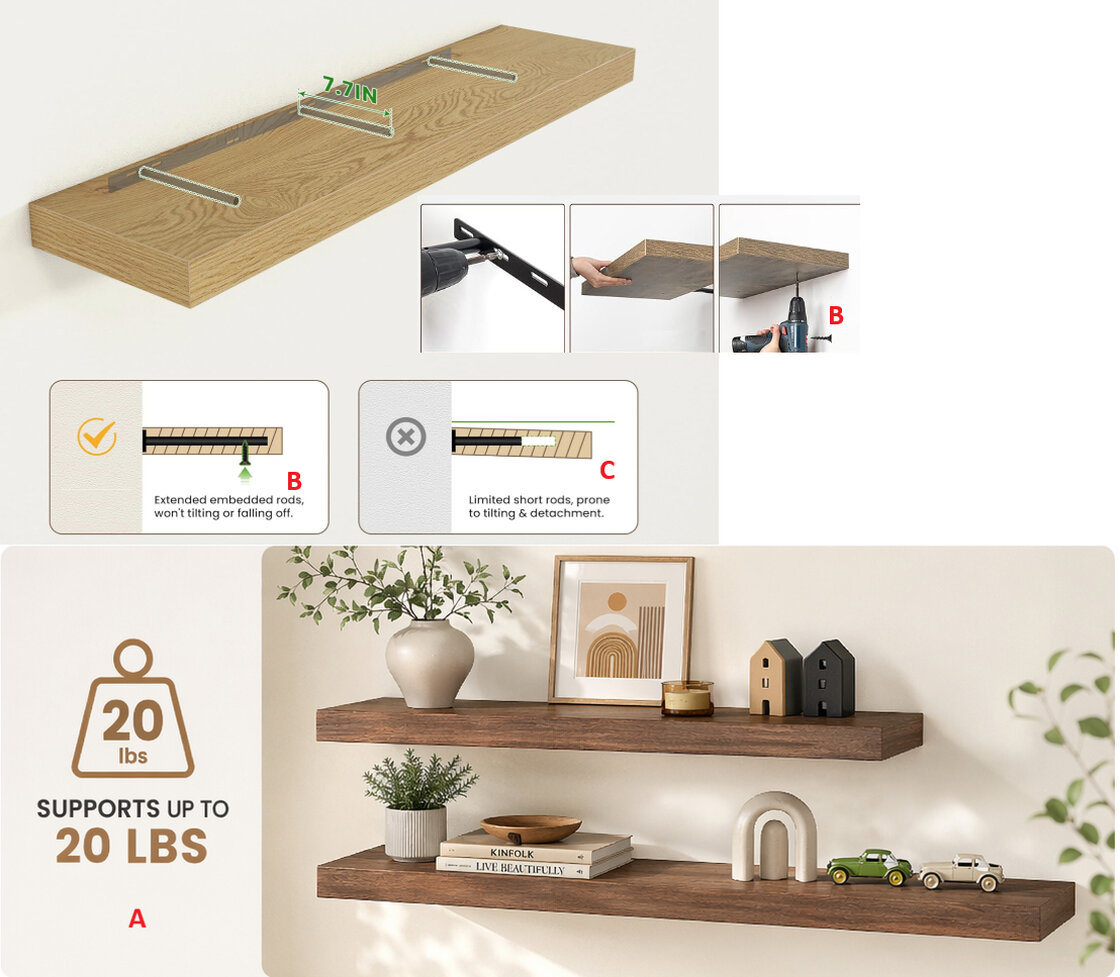
Why Floating Shelves Are Not Always Safe
April 16, 2026
Recently, I had a very disappointing experience.
I was installing floating wall shelves for a client through one of the handyman job platforms. The project involved installing shelves in the wall niches on both sides of a fireplace — four shelves on the left and four on the right, all mounted on a brick wall.
Each shelf was secured with eight holes drilled into the brick, properly sized plastic anchors, and screws. At first glance, it seemed like an extremely solid installation. What could possibly be more secure?
But the next day, I received a one-star review and a very negative comment from the client. According to the review, the client placed books on the shelves, and “half the shelves pitched forward and two of them completely collapsed in under 24 hours.”
My first thought was: how could that even happen? The shelves were mounted into brick, with eight anchors per shelf. It seemed impossible that they could simply tilt forward and collapse like that.
Unfortunately, the platform that assigned me this job does not allow handymen to respond to customer reviews. My attempt to contact support and ask them to request photos from the client was also unsuccessful. So I was left alone with my one-star rating and my own thoughts about what may have actually happened.
Later, I decided to write down my reasoning here so that you, my clients and readers, do not end up in a similar unfortunate situation.
1. Pay attention to what sellers show in their photos
If you look at the product photos for many floating shelves, you will usually see them holding lightweight items such as toys, small decorations, picture frames, or similar décor items (Letter A on the picture). These are not heavy loads.
If you look at the product specifications, you will often find a maximum weight rating. In many cases, that rating is around 20 lbs. Sometimes sellers claim much more, but I personally have doubts about those numbers.
Why? Because another important detail is the shelf material itself. Very often, the shelf is made from something described as engineered wood or a similar composite product. In reality, some of these materials are much softer and weaker than solid wood.
2. What happens when you place heavy books on the shelf?
When a heavy load such as books is placed on this type of shelf, the shelf body can begin to deform internally because the material is relatively soft (Letter C on the picture).
As the shelf deforms, a gap can develop inside the shelf around the metal support rods. Once that happens, the shelf can begin to slide outward along the metal brackets.
In other words, the wall bracket itself may remain firmly attached, but the shelf body may start moving forward because the material around the internal support channels is no longer holding tightly.
3. Once the shelf slides forward, leverage increases
And here is where basic physics comes in.
The farther the shelf slides out along the metal rods, the greater the leverage placed on the anchors in the wall. Even if the anchors were installed correctly, the increased leverage can put much more stress on the mounting system than it was originally designed to handle.
So the real issue may not always be poor installation. In some cases, the problem is the combination of:
- soft shelf material,
- heavy items placed on the shelf,
- lack of locking screws,
- and increased leverage as the shelf shifts forward. My recommendations 1. Tell the installer what you plan to place on the shelves Before the work begins, explain to the professional exactly what you want to store on the shelves. Based on experience, they may recommend a stronger and safer solution. 2. Never buy floating shelves that do not have locking screws underneath Those small screws are very important (Letter B on the picture). They help prevent the shelf from sliding outward along the metal rods under load. 3. Be skeptical of very high weight claims If a seller claims that a floating shelf can hold 70 lbs or more, treat that claim carefully. Always consider the actual shelf material, mounting method, and what kind of wall it will be attached to. 4. If you need shelves for books, buy shelves designed for books If your goal is to store heavy books, look for bookshelves or book storage shelving specifically designed for that purpose. These products usually have a stronger structure intended for real weight, not just decorative use. Final thoughts Floating shelves can look beautiful, but they are not always the right solution for heavy loads. In many cases, they work best for decorative items, not for large collections of books or other dense objects. If you are planning to install shelves and are not sure whether a particular product is strong enough for your needs, it is always better to ask before installation. The right shelf choice can save you from damage, frustration, and an expensive mistake.